Dropout is a technique to make AI model training more robust. The idea is excluding a small chunk of neurons during training prediction. Research showed a long time ago that it helps not to rely on a single neuron being too important. If we put this idea on a human company -- if your CEO couldn't go on vacation for four years, maybe the company relies too much on him. Let's give him a two-month sabbatical!
How does it relate to model trustworthiness? Let's start with ensembling. There is Francis Galton's "wisdom of the crowd" story -- imagine you have a country fair. And you have a prize cow -- it could be yours, just guess its weight correctly. In the story nobody out of 800 people got it right -- but the catch is that the average of their guesses was correct.
In a similar way in machine learning, it's known that the averaged prediction of independently trained models is a few points better. As a side effect, it's often very illustrative whether these models agree between themselves or not. In fact, the measure of how strongly they disagree is a great proxy score for future mistakes
The catch is that training lots of models is expensive or sometimes just infeasible. And here comes dropout -- if you turn it on at inference, you get kind of different models. Like if you drop a quarter of the people from your company, it would behave a little bit differently depending on which quarter you dropped. The cost of it is that these "models" are not really independent, so you need to generate many more predictions to get similar quality
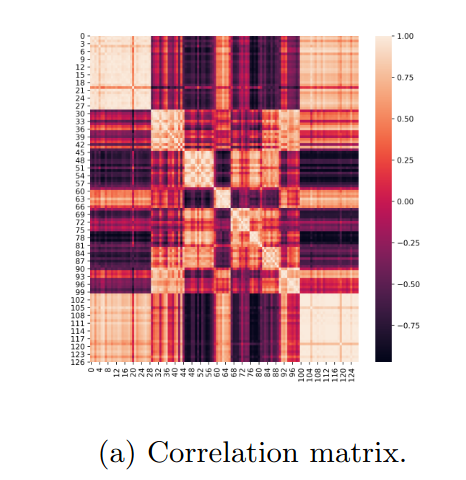
Our suggestion was to actually sample not completely at random, but take inspiration from the survey sampling, which is very good at estimating the opinion of a million people by just asking a handful of them. It is based pretty much on the fact that some people (or neurons in our case) are more similar, so you can treat them as representatives of the group. And as partial confirmation of this we found you can clearly see clusters of similarly behaving neurons in the layers (img below). So we can make like 10 times fewer forward passes than in the naive method with a comparable outcome.